Showing posts with label Babies. Show all posts

Wednesday, 29 May 2013

How could they do that to a baby?


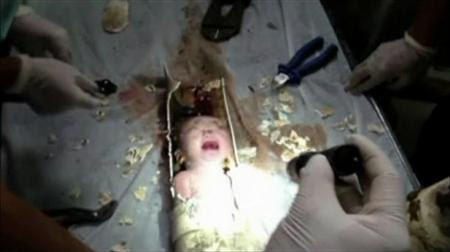
That is what people are saying after a newborn baby boy in China seems to have been flushed down a public toilet. 'How could the parents do that to a baby?'

But we should know exactly how they can do that to a baby. We are doing worse, not in extremely rare cases, but to a fifth of babies here in the UK:
In 1967, the Abortion Act came into force, resulting in a huge surge in the number of abortions performed in the UK. The ratio of abortions to life births increased from 1 in 46 in 1966 to 1 in 3.8 in 2010. That's right, for every four children that make it as far as the delivery room, one was deliberately killed in the womb. Next time see a handful of kids playing in the park, spare a thought for the one who never got the chance. [this comes from Steve Jeffrey's blog post: The Truth about Life Expectancy]
And all off this hot on the heels of the conviction of Dr Kermit Gosnell in the States. The moral high ground is not geographically located in the 'West' on this one. 

Tuesday, 4 December 2012

Sometimes the mask slips


Astute observation from Archbishop Cranmer as he reads some amazing coverage of news of a royal pregnancy. Even papers like the Guardian speak in glowing terms of the 'Royal Baby' (they quote Barak Obama's press secretary congratulating William and Kate on their first child!)

Surely such 'pro-choice' newspapers and journals (and people) should be talking about a bunch of pluripotent stem cells, an embryo or a foetus? For reports suggest that the Duchess is still in her first trimester, so this is not yet a baby; and certainly nothing with any kind of destiny. At this stage, surely, it is a non-person, just like the other 201,931 non-persons who last year were evacuated from wombs in England, Scotland and Wales. 
Or are royal foetuses endowed with full humanity from the point of conception?
Read more here.

Tuesday, 6 November 2012

Saying Goodbye

‘Miscarriage is often something that’s not acknowledged or talked about in the UK, and people certainly do not appreciate how utterly distressing it is for women, and indeed their extended families. 
It’s a loss of a precious life, and whether the loss happens in early or late pregnancy it’s traumatic, and a natural grief process must be allowed to happen.
Sadly a lot of doctors and nurses see miscarriage on such a regular basis, the right support and follow up advice is just not offered, which results in the vast amount of women never coming to terms with losing their baby, and sadly they are not able to move forward with their lives as they become stuck in a cycle of grief.
I am delighted to be an ambassador for a marvellous new organisation called 'Saying Goodbye'. Following losing five babies themselves, Zoe and Andrew Clark-Coates, the directors of CCEM, decided to launch the first national set of commemorative services, which will allow families to come together to mourn their babies. 
I hope that these services will be a turning point in the nation, and through this new organisation miscarriage [Saying Goodbye] will become more widely understood, and families will know that their pain and loss has been heard and recognized.’ [Robert Winston]
From Peter Saunder's Blog

HT Tudor Boddom-Whetham via FB

Thursday, 11 February 2010

Cry Baby, Lie Baby?

Behavioural experts have found that infants begin to lie from as young as six months. Simple fibs help to train them for more complex deceptions in later life.
Until now, psychologists had thought the developing brains were not capable of the difficult art of lying until four years old.
Following studies of more than 50 children and interviews with parents, Dr Vasudevi Reddy, of the University of Portsmouth's psychology department, says she has identified seven categories of deception used between six months and three-years-old.
Infants quickly learnt that using tactics such as fake crying and pretend laughing could win them attention. By eight months, more difficult deceptions became apparent, such as concealing forbidden activities or trying to distract parents' attention. (see whole article here)
HT: Mike Smith

Wednesday, 9 September 2009

Get your teeth into this!

Fun. Flexible (good to chew, hold, open/close, pick up, build into shapes etc.)
And we've got them already!
What a revelation!

[CAUTION: We use chunky pegs that can't be swallowed. And they are not too 'pinchy' either. Care needed here!]

Simeon is 9 months old (as yet has no teeth) and they are just right. I expect they will be good for a while too. Thanks to J for the tip!

Friday, 3 July 2009

Bottled Parenting

I love this

And yet, as if from nowhere, the paranoia rises.
Should Simeon be able to roller blade ?
And are we 'holding him back' because we are not giving him this brand of bottled water?

;)

Tuesday, 19 May 2009

1000 days

One thousand days. That’s roughly how long it takes for a newborn baby, muling and puking in his mother’s arms, to be miraculously transformed into a walking, talking little boy, bursting to break out of domesticity and into the wider world. If all’s gone well in those thousand days, he’ll have moved far beyond his native Stone Age heritage.

He’ll have a growing understanding not only of the natural world and the fundamentals of human nature but also of his own technological age, and he’ll have more than 500 words to help him to learn more and tell excitedly about his findings. But it depends — particularly in the first 18 months — on personal care. In a society obsessed with systemised solutions, we’ve forgotten the significance of love in raising happy, balanced children. It’s led us to accept practices which — in a healthy, wealthy society, after more than 50 years of peace and prosperity — are frankly shameful.


Sue Palmer in the Times today writes on Why nursery schools are bad for little boys. I enjoyed this article, which makes some telling and empathetic observations about the difficulties of parenting in this 'modern' age.
It suprises me though that some of these comments need to be made at all in a broadsheet. Surely a child could tell us most of this. Why are we so slow to see it?

The British economy has now adjusted to women’s independence and the cost of living has gone up to take account of their earnings. Taking several years off the career ladder and/or losing several years’ pay is a luxury many mothers no longer feel they can afford. In the space of a couple of decades, a huge daycare industry has grown up to fill the childcare gap. And much of that industry consists of institutional care.

There is a world of difference between personal loving attention in a familiar domestic environment and the sort of care that can be provided by a day nursery for children under 3. Unless staff ratios are extremely high, there’s little chance of much one-on-one attention and no one is likely to be as attuned to a particular infant’s wavelength as his or her own dedicated carer.

in the UK where many private nurseries are run on a shoestring, staff are often low-paid and poorly qualified, and there may be a worryingly high turnover. To ensure a baseline of “good practice”, the Government has introduced a legal framework of accountability procedures, which means that nursery workers are kept busy with bureaucracy and box-ticking. This eats into the time available for personal interaction with the children and lowers morale, leading to more staff absences and problems with turnover.

scores on school tests are not the only measure of wellbeing in early childhood. Indeed, focusing on the academic at this stage seems rather to miss the point: long-term academic success, like long-term emotional resilience and social competence, is rooted in a young child’s sense that he is loved and secure.

Child-rearing wisdom has traditionally been handed down through the female line, and cross-generational contacts between both genders are desperately needed in the 21st century. In a fragmented modern world, it’s difficult for young parents to make informal, non-professional contacts with other mothers and surrogate grandparents — but it shouldn’t be beyond the combined power of the web and local children’s services to match people of similar profiles who’d have a good chance of hitting it off and forging long-term relationships.

If boys are to receive the high-quality personal attention they need at the start of their lives, we have to find 21stcentury ways of tipping the domestic balance away from systems and institutions and back to personal interaction and parental collaboration. Because without the love, learning and language that comes from personal care, boys are more likely than girls to grow “colder, sadder, more stressed and more aggressive” with every passing year.


In her call for local organisations to be actively involved in 'making personal interaction and parental collaboration' available she speaks of the involvement of a wider network of family and friends, and against the fragmentation of our society. Good for her - even if she seems to only have a pragmatic basis for this.

But what about the role of a local church?

You must teach what is in accord with sound doctrine. 2 Teach the older men to be temperate, worthy of respect, self-controlled, and sound in faith, in love and in endurance. 3 Likewise, teach the older women to be reverent in the way they live, not to be slanderers or addicted to much wine, but to teach what is good. 4 Then they can train the younger women to love their husbands and children, 5 to be self-controlled and pure, to be busy at home, to be kind, and to be subject to their husbands, so that no-one will malign the word of God. 6 Similarly, encourage the young men to be self-controlled. (Titus 2:1-6)

Thursday, 2 April 2009

Never work with....


We followed all these instructions when introducing Simeon to Hector, by bro's tortoise.
But I am not sure it worked!!

Wednesday, 11 March 2009